
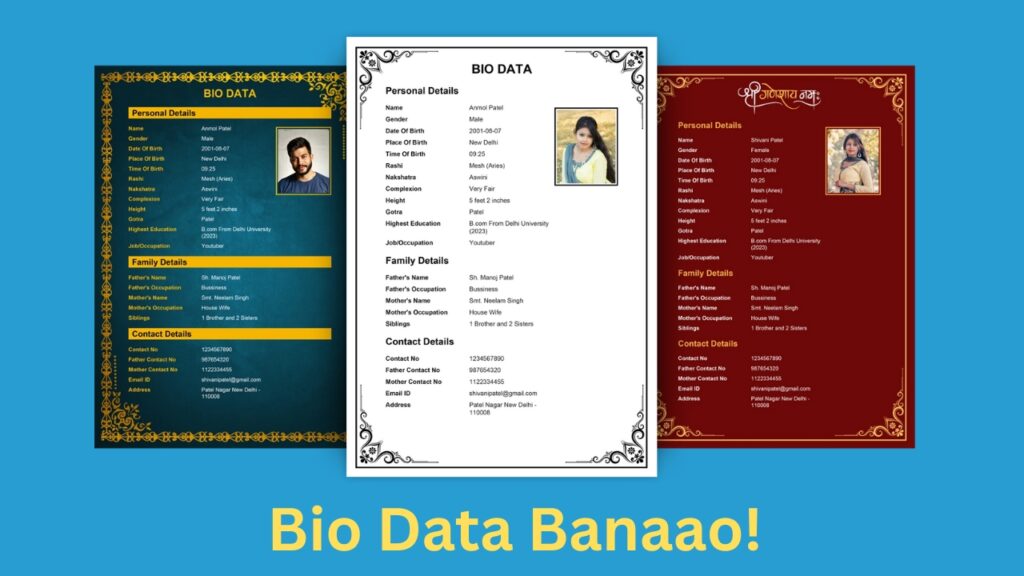
Biodata is a concise document that provides essential details about an individual, typically used for professional, educational, or matrimonial purposes. Unlike a resume or CV, which focuses on career achievements, biodata includes personal, educational, and professional information in a structured format. It is commonly used in job applications, marriage proposals, and academic admissions.
In this article, we will discuss what biodata is, its different types, how to create an effective biodata, and the key differences between biodata, resumes, and CVs.
What is Biodata?
Biodata (short for “biographical data”) is a detailed document that highlights an individual’s personal, educational, and professional background. It is often required in situations where a comprehensive personal profile is necessary, such as:
Job Applications (especially in government sectors)
Marriage Proposals (for matrimonial purposes)
Academic Admissions (scholarships, research positions)
Visa and Immigration Processes
Biodata is more rigid in structure compared to resumes and CVs, as it follows a fixed format with specific sections.
Types of Biodata
There are primarily three types of biodata:
1. Personal Biodata
Used for non-professional purposes, such as marriage proposals or family records. It includes:
Full name
Date of birth
Gender
Religion/Caste
Family background
Hobbies and interests
2. Professional Biodata
Used for job applications, promotions, or career-related purposes. It includes:
Career objective
Work experience
Skills and certifications
Educational qualifications
References
3. Educational Biodata
Used for academic purposes, such as scholarships or university admissions. It includes:
Academic achievements
Research work
Extracurricular activities
Projects and publications
How to Make an Effective Biodata
Creating a well-structured biodata is essential to make a good impression. Follow these steps:
Step 1: Choose the Right Format
Biodata is usually written in a chronological or tabular format. The most common sections include:
Personal Details
Full Name
Date of Birth
Gender
Nationality
Contact Information (Phone, Email, Address)
Career Objective (Optional)
A brief statement about your professional goals (for job applications).
Educational Qualifications
List degrees in reverse chronological order (latest first).
Include institution names, years of study, and grades.
Work Experience
Mention job titles, company names, duration, and key responsibilities.
Skills & Certifications
Technical skills (e.g., programming, design)
Soft skills (e.g., communication, leadership)
Certifications (if any)
Additional Information
Languages known
Hobbies & interests
Achievements & awards
References (Optional)
Names and contact details of professional references.
Step 2: Keep It Concise and Error-Free
Use clear, formal language.
Avoid lengthy paragraphs; use bullet points.
Proofread for spelling and grammar mistakes.
Step 3: Customize for the Purpose
For jobs, focus on skills and experience.
For marriage biodata, emphasize family background and personal values.
For academic biodata, highlight research and projects.
Difference Between Biodata, Resume, and CV
| Feature | Biodata | Resume | CV (Curriculum Vitae) |
|---|---|---|---|
| Length | 1-2 pages | 1 page | 2+ pages |
| Purpose | Personal & professional | Job applications | Academic/Research roles |
| Content | Personal details, education, work exp. | Career summary | Detailed academic history |
| Flexibility | Fixed format | Customizable | Highly detailed |
Sample Biodata Format
PERSONAL DETAILS
Name: John Doe
Date of Birth: 15th March 1990
Gender: Male
Nationality: Indian
Contact No.: +91 9876543210
Email: john.doe@example.com
CAREER OBJECTIVE
To secure a challenging position in a reputed organization where I can utilize my skills and contribute to the company’s growth.
EDUCATIONAL QUALIFICATIONS
| Degree | Institution | Year | Percentage |
|---|---|---|---|
| MBA | XYZ University | 2020 | 85% |
| B.Tech | ABC College | 2018 | 78% |
WORK EXPERIENCE
Company: Tech Solutions Ltd. (2021-Present)
Role: Marketing Manager
Responsibilities: Digital marketing, client management
SKILLS
Digital Marketing
MS Office
Leadership
LANGUAGES KNOWN
English, Hindi, Spanish
HOBBIES
Reading, Traveling, Photography
REFERENCES
Available upon request.
Conclusion
Biodata is a crucial document for various personal and professional needs. By following a structured format and tailoring it to the specific purpose, you can create an impressive biodata that effectively presents your background. Whether for a job, marriage, or academic purpose, a well-crafted biodata can make a significant difference in achieving your goals.
Remember to keep it precise, relevant, and free from errors to leave a lasting impression.