
Ai Mahashivratri Photo And Video Trending Prompt
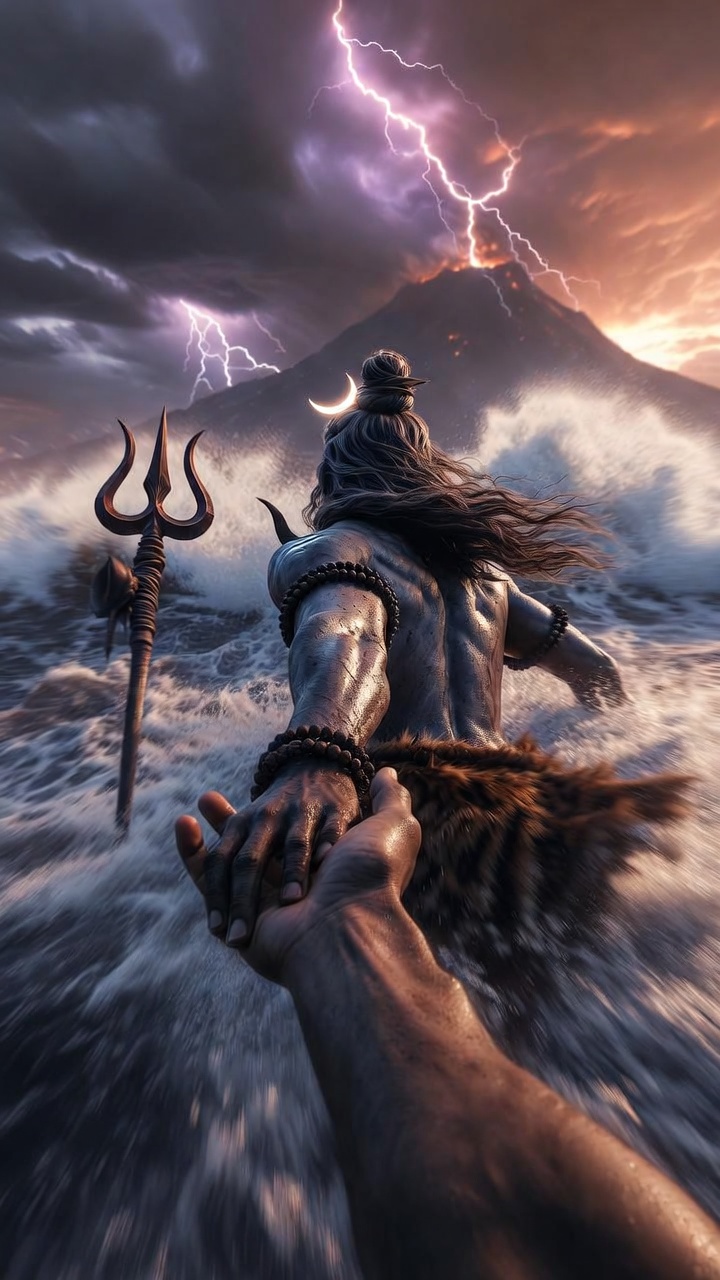
A cinematic mythological scene from a first-person POV, Lord Shiva standing in a raging ocean during a cosmic storm, Shiva holding the viewer’s hand and
pulling them forward, viewer’s hand like modern human
hand eith no wearings and slim hand, lord shiva’s
powerful muscular arm in focus, wet skin texture with
detailed veins, ash-smeared body, long matted hair
flowing in the wind, trident (Trishul) holding in his
another hand, crescent moon in his hair, tiger-skin cloth
around waist, and he is only visible from back side.Massive waves crashing around, dark storm clouds, lightning striking the sky, glowing volcanic mountain
erupting in the background, dramatic orange and purple
sky, epic scale, divine aura, godly presence.
Ultra-realistic, cinematic lighting, shallow depth of field,
motion blur on water, high contrast, volumetric fog, hyper-detailed skin and environment, image in 9:16ratio, 8K, photorealistic, movie still, epic fantasy
realism.
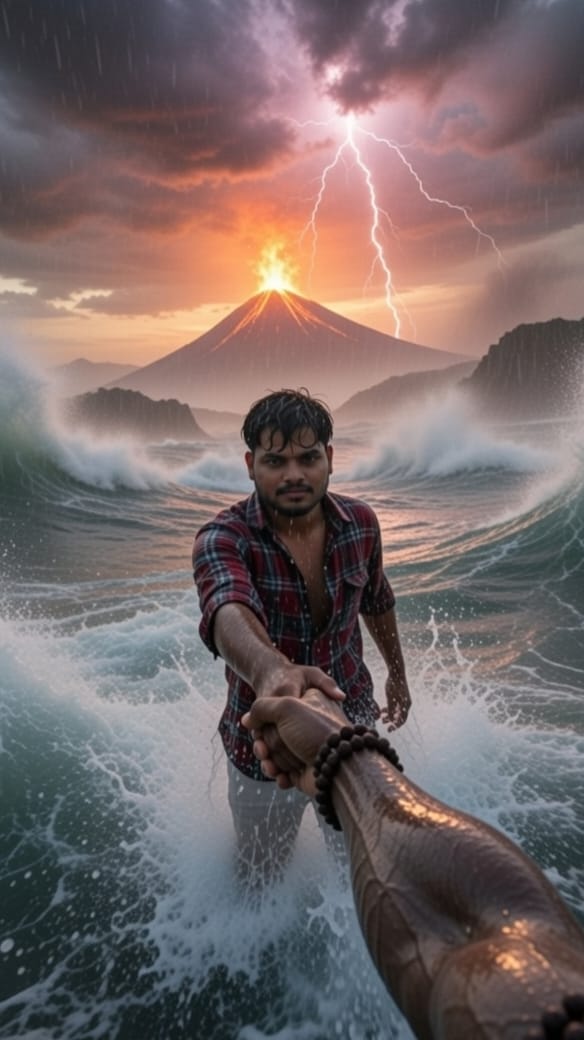
A cinematic mythological scene from a first-person POV, make me standing in a raging ocean during a cosmic storm and fully drenched, lord Shiva right hand holding the my right hand and pulling me forward, lord shiva’s powerful muscular arm in focus, wet skin
texture with detailed veins. Make only lord Shiva’s hand visible in frame.
Massive waves crashing around, dark storm clouds, lightning striking the sky, glowing volcanic mountain
erupting in the background, dramatic orange and purple
sky, epic scale, divine aura, godly presence.
Ultra-realistic, cinematic lighting, shallow depth of field, motion blur on water, high contrast, volumetric fog and dark sky, hyper-detailed skin and environment, image in 9:16 ratio, 8K, photorealistic, movie still epic fantasy realism.
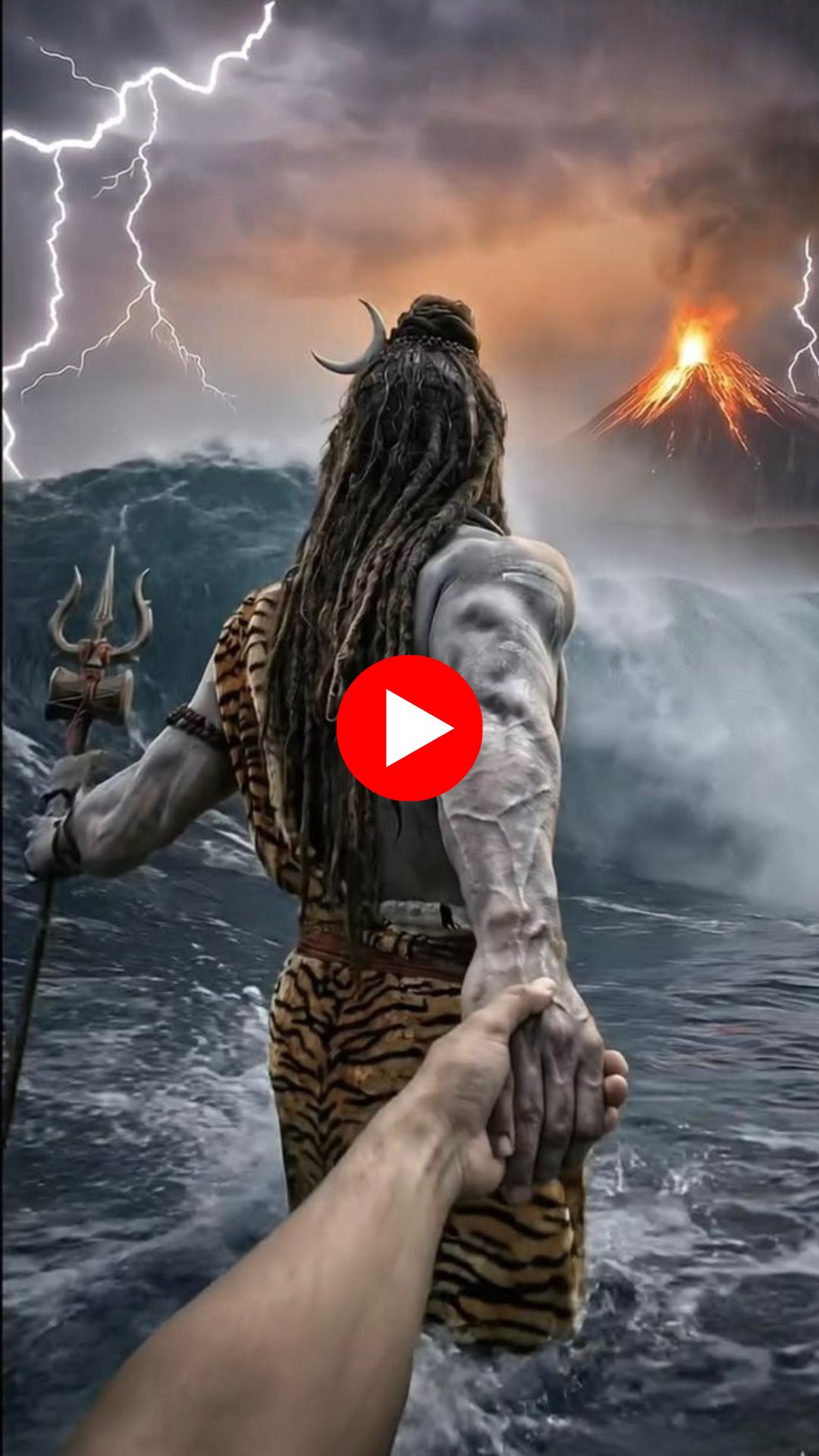
Create a single continuous cinematic shot using the two uploaded images as the start and end reference.The video begins in a first-person POV. The camera shows only the front person’s shoulder, arm, and hand holding the viewer’s hand. The camera moves forward naturally, as if the viewer is walking through ocean waves. Water splashes, rain falls, lightning flashes, and a volcano erupts in the background. Without any cuts or scene changes, the camera smoothly moves around the subject in one fluid motion, maintaining the hand-holding connection. The movement feels like a natural body-mounted camera (steady but realistic). As the camera completes the movement, it ends facing me, fully revealing my face and body while I continue
waiking forward through the water, still holding the viewer’s hand. Technical Style: Single take, one-shot camera, no cuts, no jumps, smooth cinematic motion,
realistic physics, slow motion water splashes, dramatic lighting, ultra-realistic textures, epic storm atmosphere, 4K cinematic quality, natural human movement, stable focus, no flicker.
The Digital Divine: Crafting AI Prompts to Visualize the Unseeable
Since the dawn of consciousness, humanity has sought to give form to the formless. We have painted, sculpted, and sung of gods, deities, and cosmic forces in an attempt to understand the infinite. Today, we have a new tool for this ancient pursuit: Artificial Intelligence. Generating a “God photo” with AI is not a mere technical task; it is a modern act of theological and artistic exploration. It challenges us to translate abstract concepts of power, benevolence, majesty, and mystery into a language a machine can understand.
The key to unlocking these profound images lies not in a single command, but in a carefully constructed prompt—a detailed set of instructions that serves as your creative prayer to the algorithm.
Deconstructing the Divine: The Core Pillars of a God Prompt
To move beyond a simple “picture of God,” you must build your prompt on several foundational pillars. Think of yourself as a director briefing a cosmic artist.
1. The Essence and Domain: Who or What Are You Creating?
First, define the nature of this divine being. Are you depicting a specific deity from a known pantheon, or a conceptual force?
Specific Deity: “Zeus, the Greek god of thunder and sky.”
Abstract Concept: “A visual representation of cosmic creation, the moment of the Big Bang as a divine entity.”
Personal God: “A benevolent, genderless deity embodying pure compassion and universal love.”
Your prompt should start with this core definition.
2. Form and Anatomy: The Vessel of Power
How is this divinity embodied? This is where you decide between the familiar and the utterly alien.
Anthropomorphic (Human-like): “A majestic figure with a wise, ageless face, long flowing hair woven from starlight, and hands that hold galaxies.”
Elemental & Natural: “A deity made of swirling nebula gas, with volcanoes for eyes and rivers of liquid light flowing across its form.”
Abstract & Geometric: “A divine presence as a complex, rotating sacred geometry of gold and light, emitting a low, resonant hum.”
Celestial: “A god whose body is the cosmos itself, with arms of spiral galaxies and a heart of a supernova.”
3. The Scene and Atmosphere: Where Does Divinity Dwell?
The environment is not just a background; it is an extension of the god’s power.
The Throne Room: “Seated on a throne of fused constellations and dark matter, in a hall of floating, crystalline mountains.”
The Void of Creation: “Floating in the primordial void, surrounded by nascent galaxies and swirling clouds of cosmic dust.”
The Natural Temple: “Emerging from the heart of an ancient, giant sequoia tree in a misty, sun-dappled forest, where every leaf glows with inner light.”
The Urban Divine: “A god of time, standing invisibly in a bustling futuristic city, with people and traffic blurring through its translucent form.”
4. Lighting and Color: Painting with Emotion
Light and color are your primary tools for evoking feeling.
Lighting Keywords: “Divine luminescence,” “ethereal backlighting,” “soft internal glow,” “dramatic god rays,” “cinematic lighting,” “bioluminescent veins.”
Color Palettes: “A palette of cosmic purple, deep gold, and nebula blue.” “Monochrome white and silver, representing pure spirit.” “Fiery red and orange, for a god of destruction and rebirth.”
5. Style and Rendering: The Artist’s Hand
This dictates the “feel” of the image, from a classical painting to a hyper-realistic photo.
Artistic Styles: “In the style of a Baroque painting by Caravaggio,” “a concept art painting by Android Jones,” “a stained-glass window come to life.”
Mediums: “Photorealistic,” “oil on canvas,” “digital painting,” “celestial watercolor.”
Technical Camera Specs (for a ‘photo’ feel): “Wide-angle lens, f/1.8 aperture for a shallow depth of field, high resolution, 8K, photorealistic.”
Putting It All Together: Sample Prompts for Different Visions
Here are examples of how these pillars combine into a single, powerful prompt.
Prompt 1: The Cosmic Creator
“Photorealistic portrait of a cosmic creator deity. Its form is androgynous and humanoid, but composed of a transparent, swirling nebula where galaxies are born. The face is wise and serene, with eyes that are twin supernovas. It is floating in the vibrant Pillars of Creation nebula, emitting a soft internal glow. Cinematic lighting, wide-angle lens, 8K, hyper-detailed.”
Prompt 2: The Goddess of Nature
“A majestic goddess of nature and life, emerging from an ancient oak tree in a mystical forest. Her skin is like polished bark with glowing green moss, her hair is flowing ivy and waterfalls, and butterflies of light flutter around her. Sunbeams filter through the canopy, creating a magical, ethereal atmosphere. Style of a fantasy digital painting by Ross Tran, highly detailed, vibrant colors.”
Prompt 3: The God of Forges and Craft
“A powerful, muscular god of the forge, standing in a colossal, celestial workshop. He is illuminated by the intense glow of a star he is hammering into shape on an anvil of neutron star material. Sparks flying are new-born stars. He is covered in intricate, glowing runes. Dark, dramatic lighting with strong contrasts, style of concept art for a AAA video game, unreal engine 5 render.”
The Ethical and Philosophical Dimension
Creating images of the divine with AI is not without its weight. It forces us to confront our own biases and beliefs. The “face of God” generated will inevitably be a reflection of human art, culture, and the data the AI was trained on. It is a mirror, showing us not a universal truth, but the current state of our collective imagination.
Respect is key. When depicting deities from living cultures, approach with sensitivity. The goal is not to define a faith, but to explore the universal human impulse to create and imagine the sacred.
Conclusion: The Modern Mosaic
In the past, we had Michelangelo’s Sistine Chapel. Today, we have the prompt box. The act of carefully crafting these words—choosing the right adjective for the light, the perfect metaphor for the form—is a deeply creative and contemplative process. You are not just typing; you are building a vision.
The AI is your collaborative partner, a digital apprentice that helps you mosaic millions of artistic influences into a new, personal icon. So, open your notebook, ponder the infinite, and begin to write. Your unique vision of the divine is waiting to be rendered, one carefully chosen word at a time.